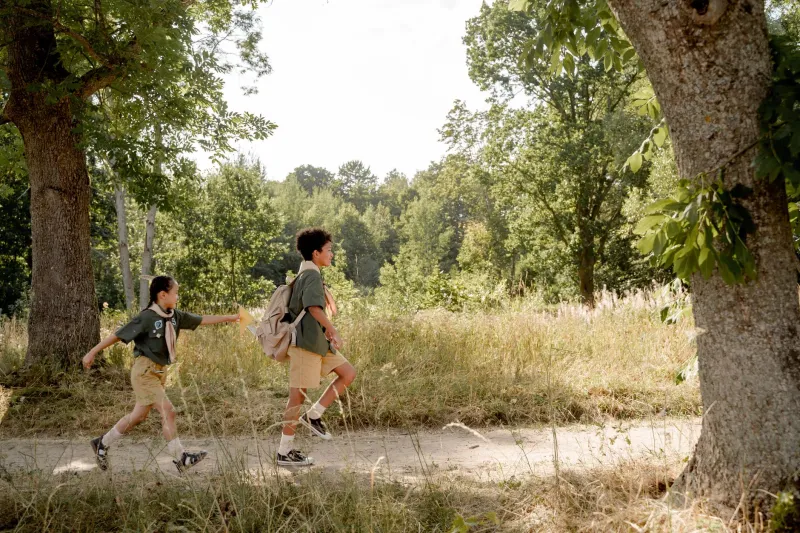
Unplugged and Unleashed: What Really Happens to Your Kid's Brain After a Summer Without Screens

Somewhere around day three, it happens. The phantom phone-checking stops. The fidgeting settles. A kid who spent the entire car ride to camp refreshing TikTok is suddenly, genuinely absorbed in learning how to tie a bowline knot — and nobody had to tell them to put anything away.
Parents who've sent their children to Camp North End describe this shift almost universally. It's not magic, and it's not punishment. It's neuroscience playing out in real time under an open northern sky.
Why the Wilderness Works Where Parental Rules Don't
Here's the uncomfortable truth about screen time limits: willpower is a terrible long-term strategy. When a kid puts down their phone because a parent said so, the phone is still there. The pull is still there. The brain hasn't changed — it's just waiting.
Remote wilderness settings operate differently. When there's no signal and no Wi-Fi, the choice to disengage isn't a choice at all. And that's actually the point.
Research from the University of Colorado found that just four to six days in a nature-immersive environment — away from screens — measurably improved performance on creative problem-solving tasks by nearly 50 percent. The brain, freed from the constant dopamine drip of notifications, begins recalibrating. It starts seeking stimulation from the environment around it rather than from a glowing rectangle.
At Camp North End, that environment happens to include kayaking routes that wind through glacial lakes, fire-building challenges that require genuine focus, and night skies so dense with stars that even the most phone-dependent teenager tends to just... look up.
The Dopamine Reset Nobody Talks About
Social media platforms are engineered — and that's not hyperbole, it's the word their own developers use — to deliver unpredictable reward signals. A like might come in two seconds or two hours. That unpredictability is exactly what makes the behavior compulsive. It's the same mechanism that makes slot machines so hard to walk away from.
After weeks of this pattern, a teenager's brain begins to require higher and higher stimulation just to feel engaged. Homework feels unbearable. Conversations feel slow. The real world, frankly, feels boring.
The wilderness disrupts this cycle not by offering less stimulation, but by offering different stimulation — stimulation that builds rather than depletes. Successfully navigating a canoe through choppy water produces a dopamine response, but it's one tied to real-world effort and genuine accomplishment. That's a fundamentally different neurological experience than getting 40 likes on a post.
Marcus, a 16-year-old from suburban Chicago who attended Camp North End last summer, put it simply: "By week two, I stopped missing my phone. By week four, I kind of dreaded going back to it. That was weird to realize."
His mom noticed the difference before he even finished unpacking. "He came home and actually sat at dinner and talked to us. Like, full sentences, eye contact. It lasted." She paused. "Well, mostly."
What Counselors Actually See
The staff at Camp North End aren't therapists or neuroscientists — they're outdoor educators, former athletes, and wilderness guides. But they've watched this pattern play out enough summers to recognize the arc.
Week one is usually the hardest. Kids are restless. Some get headachy. A few get genuinely irritable in ways that feel disproportionate to the situation. Counselors describe this phase without judgment: it's withdrawal, plain and simple, and it's real.
By week two, something loosens. Kids start initiating activities rather than waiting to be told what to do. Friendships deepen because conversations have nowhere else to go — there's no retreating to a screen when things get awkward. You work through it, or you sit in the awkwardness, and either way you grow.
By week three and four, counselors say they see the kids they suspect these teenagers actually are underneath the digital noise. Curious. Funny. Capable of boredom — and of filling that boredom creatively.
Keeping the Reset Going After Drop-Off Day
This is where most families stumble. The camp effect is real, but it's not permanent by default. A kid who spent four weeks rewiring their relationship with technology can undo a surprising amount of that progress in a single Netflix binge weekend if there's no intentional structure waiting at home.
The good news is that maintaining the benefits doesn't require banning phones forever. It just requires some deliberate scaffolding.
Create tech-free zones that aren't about punishment. Dinner tables and bedrooms are the obvious ones, but consider making car rides screen-free too. Some of the best conversations happen when there's nothing else to do.
Replace the ritual, not just the rule. If your kid spent camp mornings doing something physical before breakfast, try to preserve some version of that. A walk, a bike ride, ten minutes of shooting hoops. The body's morning movement ritual matters more than most parents realize.
Let them be bored. Seriously. Boredom is where creativity lives, and a kid who learned to tolerate it at camp can relearn it at home — if you resist the urge to fill every empty moment.
Ask about camp, often and specifically. Memory is a powerful re-anchoring tool. Asking "what's something you miss about camp?" isn't nostalgia — it's helping your kid reconnect with a version of themselves they actually liked.
Plan the next outdoor experience before summer ends. A fall camping trip, a weekend hike, even a day at a state park. Keeping the thread alive matters.
The Bigger Picture
The goal of a digital detox at Camp North End was never to make your kid hate technology. That's not realistic, and it's not the point. Technology is woven into every career, every classroom, and most friendships your child will ever have.
The goal is to give them a reference point. A felt memory of what it's like to be fully present — in a conversation, in a landscape, in their own head — without a screen mediating the experience. Kids who have that reference point make different choices. Not perfect choices, but more conscious ones.
Marcus, back in Chicago and back in school, still checks his phone plenty. But he also goes outside more. He joined the cross-country team. He calls his camp friends on actual phone calls, not just DMs.
"I think I just know now that I can do stuff without it," he said. "I didn't know that before."
That's the Camp North End effect. One summer. A fundamentally different relationship with the world.
Not bad for a few weeks without Wi-Fi.