What Happens Around the Fire That Can't Happen Anywhere Else
Picture your kid at home on a typical Tuesday night. Phone in hand, earbuds in, door maybe half-closed. You ask how their day went. You get "fine." You ask what they're thinking about. You get a shrug. It's not that they don't have feelings—they have plenty. It's that nothing in their everyday environment is asking those feelings to come out.
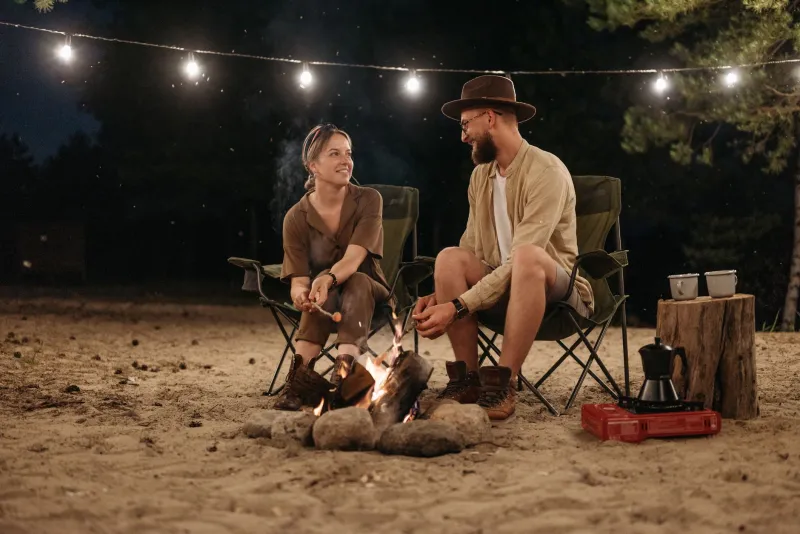
Now picture that same kid, eight days into a northern wilderness session, sitting around a fire with seven other campers after a day that included a tipped canoe, a three-mile portage, and a thunderstorm that rolled in from nowhere. Someone starts talking about how scared they were. Someone else admits they almost cried. Then your kid says something—something real, something honest—and the group leans in.
That moment? That's not an accident. That's the northern campfire doing exactly what it's designed by nature to do.
Why the Wilderness Lowers the Walls
Psychologists who study adolescent development have a term for the kind of social mask most kids wear through their school years: impression management. It's the constant, exhausting work of controlling how others perceive you. In a classroom, at the lunch table, on social media—kids are always performing. The stakes feel high, the audience is always watching, and vulnerability feels like a liability.
Wilderness environments disrupt that dynamic in a way that few other settings can. When you've just white-knuckled your way through a set of northern rapids, or spent an hour trying and failing to get a fire going in the rain, the social hierarchy that ruled your middle school hallway suddenly seems pretty irrelevant. Shared struggle has a remarkable way of equalizing a group.
Research published in journals on environmental psychology consistently finds that time in natural settings reduces what's called "cognitive load"—the mental energy we spend on self-monitoring and social performance. When that cognitive pressure eases, emotional honesty tends to rush in to fill the space. Kids who would never dream of admitting they were nervous or overwhelmed in front of their school friends will say it plainly to a group of fellow campers, because the campfire doesn't feel like a performance venue. It feels like a safe room.
The Fire Itself Is Doing Something
Here's a detail that might surprise you: researchers at the University of Alabama studied the physiological effects of watching a fire and found that it actually lowers blood pressure and induces a relaxed, socially receptive state. They theorized that for our ancestors, fire represented safety, warmth, and community—and that our nervous systems still respond to it that way on a deep, almost instinctual level.
At Camp North End, we didn't need the research to tell us this. We've watched it happen hundreds of times. The campfire is where the real conversations start. Not the icebreaker games, not the structured team-building exercises—those matter too—but the campfire is where a kid who's been guarded all week suddenly starts talking about something that actually matters to them.
There's also the matter of what the fire replaces. When there are no screens, no playlists, no group chats demanding attention, the social energy that kids normally route into digital interaction has nowhere to go except into the actual humans sitting next to them. That's not a small thing. For a generation that has grown up communicating largely through text and emoji, being forced into face-to-face conversation—with eye contact, real-time emotional reading, and no delete button—is genuinely transformative.
What Emotional Intelligence Actually Looks Like in the Wild
Emotional intelligence, as most developmental psychologists define it, involves four core skills: recognizing your own emotions, managing them, reading the emotions of others, and navigating relationships effectively. All four of those skills get a serious workout around a northern campfire.
When a kid says "I was really frustrated today when I couldn't keep up on the trail," they're practicing the first skill—naming what they felt. When their tentmate responds with empathy instead of dismissal, they're both practicing the second and third. And when the group figures out how to support the kid who's struggling without making them feel singled out, that's the fourth skill in action.
These aren't abstract concepts being taught in a lesson. They're being lived in real time, with real consequences, in a context where the emotional stakes are genuine. That's why they stick.
Counselors at northern camps are trained to facilitate these moments without forcing them. There's a significant difference between a structured sharing circle (which has its place) and the organic conversation that emerges when a group of tired, satisfied kids is warming their hands after a hard day. The counselor's job around the fire is often just to be present, to model openness, and to ask the right question at the right moment.
The Friendships That Come Out of It
Here's what parents notice when their kids come home from a northern summer: the friendships they've made don't look like their school friendships. They're different in a way that's hard to put a finger on at first.
The difference is that these are relationships that were built during moments of genuine vulnerability. When you've seen someone struggle and helped them through it—when you've admitted your own fear to someone and had them take it seriously—you've created a bond that small talk and shared classes simply can't replicate.
Many camp alumni describe their camp friends as the first people they were ever truly themselves around. Not a curated version, not the version optimized for social approval—just themselves. That experience, often happening for the first time around a northern fire pit, teaches kids something profound: that being authentic is not just survivable, it's actually what draws people close.
That's a lesson that transfers. The kid who learns to be emotionally honest at camp tends to carry that capacity into high school friendships, into college relationships, into the workplace. They know how to say what they mean. They know how to listen. They know that admitting struggle doesn't make you weak—it makes you someone worth knowing.
What You Can Do With This at Home
You don't have to recreate a northern wilderness in your backyard to keep this momentum going—though a firepit and a no-phones rule on a Friday night is a genuinely good start. The bigger move is recognizing that your kid has developed a new capacity over the summer, and giving it room to breathe.
Ask different questions. Instead of "how was your day," try "what was the hardest part of today?" or "what surprised you this week?" These are campfire questions. They assume that something real happened, and they invite a real answer.
And when they give you one—even if it's uncomfortable, even if you're not sure what to say—lean in. That's what the fire taught them to do. They're just waiting to see if you'll do it too.